
Author: Kevin George
Coming Soon! Target date of October 1, 2023.
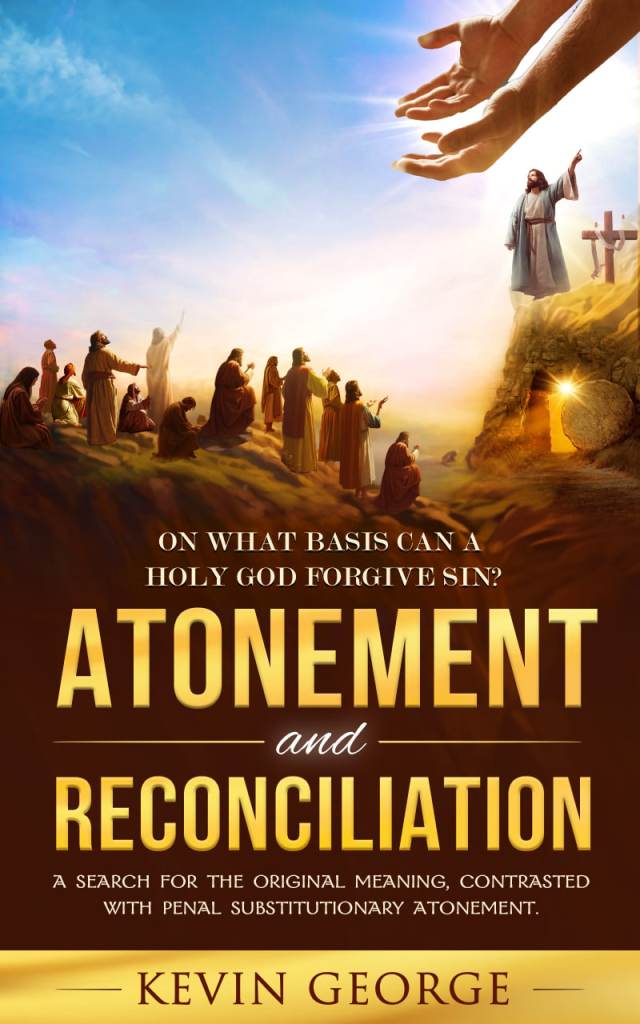
A search for the original meaning, contrasted with Penal Substitutionary Atonement
The following is a very CONDENSED version of Chapter 1.
“Shall I give my firstborn for my transgression, the fruit of my body for the sin of my soul?” He has told you, O man, what is good; and what does the LORD require of you but to do justice, and to love kindness, and to walk humbly with your God?” Micah 6:7b-8
On what basis does a holy God offer forgiveness for our sins so we can have a right standing before Him? We all want forgiveness, and a misunderstanding or lack of feeling forgiven can generate an erroneous method of seeking it, leading to horrible consequences such as self-immolation and even child sacrifices. For the last 500 to 1000 years, Protestant Christianity has offered an explanation of how God forgives, called Penal Substitutionary Atonement. This view frames the atonement in legal terms, with God as a judge in a courtroom.
Many critics now question the penal substitution teaching, as it claims that God would not, or could not, forgive our sins unless and until men tortured and murdered His innocent son, thereby somehow paying Him for humanity’s sin debt in order to meet an infinite perfection of justice. The doctrine is taught as a loving God who provides a willing substitute to take our place in punishment and death, so that He can now accept sinful humanity.
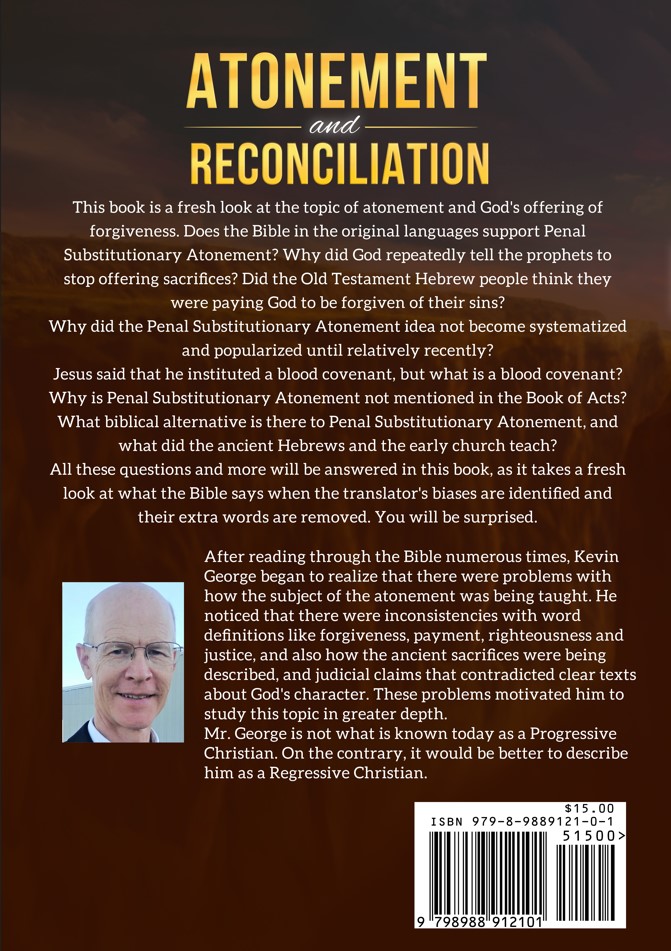
This book examines Penal Substitutionary Atonement (abbreviated as PSA), and will provide a biblical explanation of an alternative view which this author calls Reconciliational Atonement, or, Repentance and Reconciliation Atonement, or, Relational Atonement. Not all churches within what is generically called “Christianity” teach Penal Substitutionary Atonement, as it is predominantly a Protestant doctrine. The Catholic and Greek Orthodox churches are exceptions, mentioned in Chapter 2. Nevertheless, the prevailing view within much of Christianity today is some form of PSA, with various nuances or emphasis in different groups.
This book will briefly review the most common atonement teachings throughout church history. Then Penal Substitutionary Atonement (PSA) will be examined logically and biblically and other atonement factors will be considered. Finally, essential scripture passages will be investigated. Reconciliational Atonement results in ceasing from sin, living godly lives, and becoming reconciled to God.
The goal of this author is to grasp a biblical teaching of atonement that fits the Old and New Testament texts within their original cultural, textual, historical, and linguistic context. This means attempting to comprehend ancient Hebraic thought and background cultural norms. This is important because interpreting the biblical texts within foreign frameworks will cause confusing theological claims that are often slippery, contradictory, and even absurd.
A good example of confusion when interpreting the biblical texts with a foreign framework is seen in books written by Leon Morris. His first book, entitled “The Apostolic Preaching of the Cross,” is often been held up as one of the best scholarly works of a detailed linguistic analysis of the key words used in defense of PSA, in which he rejects the use of redemption as a metaphor. But about 20 years later, in his second book, “The Atonement,” he switches views, concluding that it often is used as a metaphor! This demonstrates how scholars have struggled with the meaning of words related to the topic of atonement. Perhaps part of this is because they are starting with the wrong presuppositions, leading to illogical claims that can never be resolved. What if their presuppositions are replaced with concepts that made sense to the original Hebrew people, and we move on from there instead of front-loading the topic with predetermined conclusions?
This journey begins in the next chapter with a brief examination of various theories of atonement that have been proposed throughout church history.
This book emphasizes the fact that the God of the Bible is very relational, much more so than being obsessed with legal demands. Do not miss this perspective!
 Atonement and Reconciliation
6 responses to “On what basis can a holy God forgive sin?”
Kevin – Since 2011, I’ve come to many similar conclusions about atonement and ceasing from sin as I see you have here – appreciate how refreshing it is to read a few of the chapters thus far. When do you plan to release your book?
LikeLike
Hi Matt. Thank you. I appreciate any feedback. I am hoping to have it done sometime next year.
LikeLike
Next year sounds great Kevin! The only points of feedback I have so far are these:
-Improve – add a few scholarly footnote or endnote citations when describing the other theories of atonement, such as Oxford Encyclopedia or Encyclopedia Britannica, so people can see briefly the sources you used for various theories (I’ve been working on a graphic aid for a few years on atonement theories and I need to do the same thing, lol)
-Sustain – the context you give for each verse so readers can see the context is not really always atonement for sin (like you do for Ransom & PSA theories) is perfect!
-Sustain – I’m not sure if you believe in our ability to live free from sin as Christians, but I get that impression as I read what you have written (the 5-7 chapters I’ve read thus far bouncing around). Our fellowship focuses on victory over sin a lot and I love seeing the constant reminders for us to stop sinning and live righteously, as I see this as the most important aspect of the Christian walk. So whether that was intentional or not, it has been great to see!
Sorry to give you a few paragraphs to read, but just wanted to share those with you.
-Matt
LikeLike
Matt,
Yes, I do plan to add some citations. Some will be easy to find. Others, not so easy as I have yet to come across any writing that goes back and takes a new look at the Bible passages like I have. There are numerous authors who point out moral, ethical, and logical inconsistencies in PSA, but there does not seem to be much grounding in the biblical texts.
I will be going back to review everything and may add additional context where I feel it is needed. Thanks for the reminder.
I also believe in the ability to stop sinning, however, I stop short of impeccability – an inability to sin.
Kevin
LikeLike
Hi Kevin,
soon after being confronted with the gospel that the Lord Jesus Christ and his apostles preached, I left the church that I attended. Soon after I noticed that something was off with penal substitution theology and – similar to you – started writing my own set of articles and researching this very topic. It tremendously helped me taking Jesus Christ and his teachings much more seriously. On Youtube I found some comments of yours that looked quite reasonable and soon after I found your blog. There are some minor points that maybe worth considering:
2nd Corinthians 5:21 – When discussing this passage, you do a good job in arguing against PSA using the context. However, you seem to miss that the expression “he made him to be sin” can and should (as I would argue) be translated as “he made him to be sin offering.” This would be in perfect harmony with the context of this passage. After checking the Greek expression in the Septuagint (for example in Lev. 4:3, 4:21b, 4:24b, 5:12b) you will know what I mean. Please notice that I do not have any knowledge about the Greek language but tools like blueletterbible.org make it possible to handle Greek to at least some extend. Since you seem to be able of Greek – can you confirm this other translation?
1st Peter 2:24 – When discussing this passage, you again do a good job arguing against PSA using the scriptural context rather than protestant tradition. Maybe as some sort of footnote it would be worth mentioning two appearances of the word “ἀναφέρω” in the Septuagint: Numbers 14:33 and Ezekiel 36:15. The main appearances of this Greek word are specifically about OT offerings with meanings that do not fit 1st Peter 2. However, this two passages provide some sort of “hard evidence” that the meaning that you deduced from the context of 1st Peter is correct. Ezekiel 36:15 seems to be the more obvious example though.
I hope your work can be an eye-opener and a blessing for many!
Greetings from Germany.
Chris
LikeLike
Hi Chris. Thank you for the input. The information regarding 1 Peter 2:24 is good. I may include it. At the moment I am mostly working offline with a book editing program which allows me to add footnotes and other details in preparation for publishing (which I hope will happen later this year).
The claim that 2 Cor. 5:21 is about an offering is quite common. Your statement challenged me to take another look. I still disagree but can fully respect those who hold that view. Here is my conclusion, which will likely be added in some form to the book:
“For our sake he made him to be sin who knew no sin, so that in him we might become the righteousness of God.“ 2 Corinthians 5:21
Does this verse teach that Jesus was an offering for sin, a human death in place of the Old Testament animal sacrifices? Many people believe that this verse is intended to state, “For our sake he made him [an offering for] sin…”. However, there are several problems with this claim. Here are some of those problems:
1. The word “offering” is not in the text of 2 Cor. 5:21. In contrast, Jesus chose martyrdom as a fragrant-smelling sacrifice (metaphorically), not a sin sacrifice, in Eph. 5:2 “And walk in love, as Christ loved us and gave himself up for us, a fragrant offering and sacrifice to God.”
2. Direct human sacrifices were an abomination to God “You shall not worship the LORD your God in that way, for every abominable thing that the LORD hates they have done for their gods, for they even burn their sons and their daughters in the fire to their gods.” Deut. 12:31, also Deut. 18:10, Ez. 16:10
3. No man can redeem another. Ps. 49:7-8, Ezekiel 18:20
4. Jesus was beaten and severely wounded. Damaged sacrifices were not acceptable. Lev. 22:21-23, Malachi 1:8
5. Sin offering of animals for the common people were to be female goats or female lambs. Lev. 4:28, 32
6. Sacrifices for sin were to be done only on the altar, located in the temple. Deut. 12:13-14
7. There was a scapegoat offering for sin, but this one was released into the wild and not killed. Leviticus 16:9-10, 21-22
8. Sacrifices for sin did not always require the death of an animal. Flour was also allowed as a substitute. Lev. 5:11-13
9. God does not demand or need sacrifices. He expects obedience first. “In sacrifice and offering you have not delighted, but you have given me an open ear. Burnt offering and sin offering you have not required.” Psalm 40:6, 51:6, also Heb. 10:5-8, 1 Sam. 15:22.
10. If Jesus was literally “made to be sin”, then he would not have been an acceptable sacrifice to God. A polluted sacrifice would be an insult, not a gift, comparable to a husband giving wilted flowers to his wife after apologizing for an offense.
LikeLike